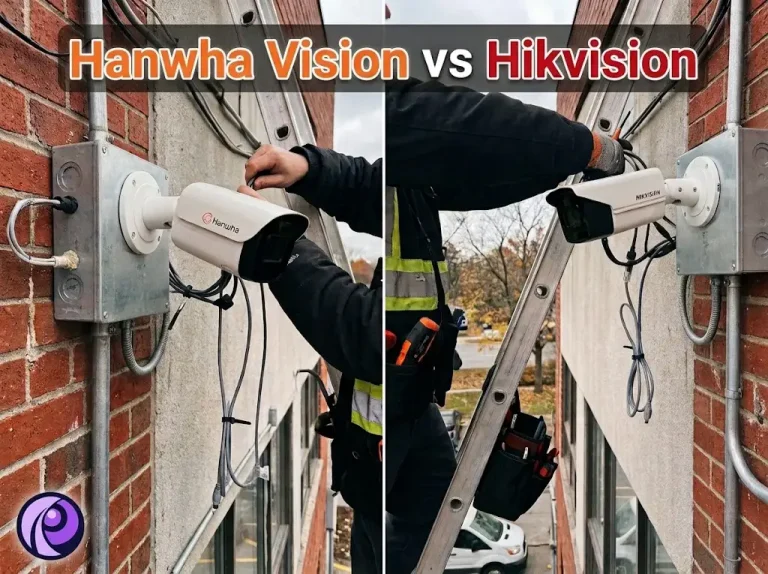
Since Ottawa ordered Hikvision’s Canadian subsidiary to close in 2025, one question keeps coming up on our site visits: if not Hikvision, then what? Hanwha Vision is usually the first name people mention. The hanwha vs hikvision decision isn’t as tidy as “Korean good, Chinese bad,” though. Each brand beats the other somewhere, and the right pick comes down to your building, your budget and who you answer to.
We install both brands as part of our security camera installation work across Toronto and the GTA, so we see how they behave on real walls, not just on spec sheets. Below you’ll find where each company comes from, how the cameras hold up in tricky spots, what has changed with support in Canada, and where Axis fits if you want a third option.
Hanwha Vision vs Hikvision at a Glance
Here’s how Hanwha Vision and Hikvision line up on the points our clients ask about most. The details behind each row come further down.
| Factor | Hanwha Vision | Hikvision |
|---|---|---|
| Headquarters | Seongnam, South Korea | Hangzhou, China |
| Ownership | Part of the Hanwha Group, a Korean business group | About 42% held through state-owned CETC, its controlling shareholder |
| Where cameras are made | South Korea and Vietnam | China |
| Status in Canada | Operating normally | Canadian subsidiary ordered to wind up in 2025; federal purchase and use prohibited |
| Typical price | Mid to upper range | Low to mid range |
| Known for | Wide dynamic range, in-house Wisenet chips, AI object detection | ColorVu colour night imaging, AcuSense alarm filtering, a huge model catalogue |
| Where it fits best | Commercial sites, condos, institutions, systems meant to last | Budget-conscious homes and small shops with no compliance pressure |
Is Hanwha a Korean Company?
Yes. Hanwha Vision is based in Seongnam, just south of Seoul, and belongs to the Hanwha Group, one of South Korea’s biggest business groups. The company is older than its name, and its history explains a lot of what you see on older systems around town:
- 1977: founded as Samsung Precision, later known as Samsung Techwin.
- 2015: Hanwha completes its purchase of the business and renames it Hanwha Techwin.
- March 2023: the security division takes the name Hanwha Vision.
So when you spot a camera stamped “Samsung” or “Wisenet” in a plaza or condo garage, it’s the same family. Wisenet is Hanwha’s product line, and plenty of those Samsung-era units are still recording today. Production happens in South Korea and Vietnam, which matters if you have to document where your equipment comes from.
Image Quality: Where Each Brand Earns Its Reputation
Put a 4MP camera from each brand side by side on a sunny afternoon and you’d struggle to tell them apart. The differences show up in the hard spots: glass entrances, dark parking areas and scenes with a lot going on.
Backlit entrances
This is where Hanwha made its name. Many of its higher-end Wisenet models handle wide dynamic range very well, so a person walking through a bright glass lobby stays recognizable instead of turning into a silhouette. If your most important camera faces a south-facing storefront door, that alone can justify the price gap.
Night footage
Hikvision’s ColorVu line earned its popularity. A wide aperture and a soft white light give full-colour footage in low light, and that’s a big part of why Hikvision ended up on so many driveways and small lots. Hanwha has capable low-light and IR models too, and with decent lighting both brands do fine. In this one category, though, ColorVu often gives you more for the money.
Smart detection and false alarms
Both brands now tell people and vehicles apart on the camera itself, which cuts the alerts you’d otherwise get from swaying branches, headlights and the odd raccoon. Hikvision calls its version AcuSense. Hanwha’s newest cameras run on its Wisenet 9 chip, released in 2025, which gives image processing and analytics a processor each. Day to day, the gap is smaller than either company’s marketing implies. How carefully someone sets up the detection zones matters more than the logo on the housing.
Cybersecurity and Trust
Here the comparison stops being about pixels. The federal government hasn’t published the evidence behind its 2025 decision, and Hikvision rejects it. What is on the public record is each company’s track record with regulators:
- Hikvision: China’s state-owned CETC holds a controlling stake. The US added Hikvision to its Entity List in 2019 and to the FCC Covered List in 2022, and Canada followed with its own order in 2025. We break down what the 2025 Hikvision order means for owners in a separate guide.
- Hanwha Vision: part of a privately owned Korean group, with no comparable government restrictions in Canada or the US. Hanwha states that its professional line meets US NDAA Section 889 rules, which is why its cameras often appear on government and institutional spec sheets.
Ownership and security aren’t the same thing, though. A Hanwha camera left on its factory password and opened to the internet is a bigger risk than a patched Hikvision camera on its own network. Current firmware, unique passwords and keeping the recorder off open ports matter for every brand.
Support and Warranty in Canada After 2025
For many owners, support settles the question more than politics does. With Hikvision Canada no longer operating, warranty claims and repairs now go through distributors and installers rather than a local manufacturer office. Our guide to Hikvision support in Canada explains how that works now. Hanwha still sells into Canada through its usual distribution channels, so firmware updates and returns follow the normal route.
Your Hikvision cameras will keep recording, and installers like us still service them. You feel the difference when something fails under warranty and you’re waiting on a replacement.
Price and Long-Term Value
Cost has always been Hikvision’s strongest card. Camera for camera, Hanwha usually costs more, and on a 24-camera warehouse system that adds up. But cameras are only part of the bill. Labour, cabling and the recorder take a large share of a typical project, so stepping up a brand moves the total less than the camera prices alone would suggest.
Hanwha tends to earn back the difference in the years after install. You get steady firmware support, fewer awkward questions from insurers or condo boards, and less worry about a supply line drying up.
Hanwha vs Axis: The Other Non-Chinese Option
Buyers who rule out Chinese brands usually end up weighing Hanwha against Axis. Both make excellent cameras. They’re just aimed at slightly different customers.
| Factor | Hanwha Vision | Axis Communications |
|---|---|---|
| Headquarters | Seongnam, South Korea | Lund, Sweden (owned by Canon since 2015) |
| Typical price | Mid to upper range | Upper range |
| Strengths | Backlight handling, premium quality at a lower price, a strong AI line-up | Open app platform (ACAP), long firmware support, deep integration with video management software |
| Where it fits best | Condos, retail, offices, warehouses | Corporate campuses, healthcare, large multi-site operations |
Axis built the first network camera back in 1996 and helped found the ONVIF standard, and you can see that engineering background in how easily its cameras work with other systems. For most GTA businesses, though, Hanwha gets you close to Axis quality for less. Axis is worth the premium when the cameras need to run custom analytics or feed a large enterprise video platform.
Which Brand Fits Your Property?
There’s no single winner, so here’s roughly how we steer the decision with clients:
| Your situation | What we usually suggest |
|---|---|
| Home with a working Hikvision system and current firmware | Keep it, tighten the settings, and revisit when it reaches end of life. |
| New home system on a tight budget | Hanwha’s mid-range line. Across four to eight cameras, the extra cost is small next to the full installation. |
| Storefront, glass entrance or bright lobby | Hanwha, for its backlight handling. |
| Condo, property management or board oversight | Hanwha. It avoids the brand questions boards now ask. |
| Federal contract, public-sector client or regulated site | Hanwha or Axis. |
| Enterprise campus or custom analytics | Axis. |
For houses, our residential security camera installation page shows how we plan coverage around the doors, driveway and yard. For offices, retail and multi-unit buildings, the commercial security camera installation page explains how we scope larger systems.
Switching From Hikvision to Hanwha Without Starting Over
If you decide to move, you rarely need to tear everything out. Doing it in stages keeps costs down and keeps you recording the whole time:
- Keep the cabling. Existing Cat6 runs and mounting points can usually be reused.
- Check the recorder. Many Hikvision NVRs accept other brands’ cameras through ONVIF. Basic video will work, but some camera-side smart alerts may not carry over.
- Start with the views that matter most: entrances, cash areas and parking access.
- Replace the recorder last, once you’re ready to move to a Hanwha NVR or its WAVE software and use the full analytics.
Not Sure Which Brand Is Right? Let’s Look at Your Site
A 30 to 60 minute site visit usually settles it. We look at your lighting, entrances, existing cabling and any compliance needs, then quote both brands side by side so you can see the real difference in cost. Book a free on-site assessment or call us. We work across Toronto, North York, Mississauga, Markham, Vaughan and the rest of the GTA.