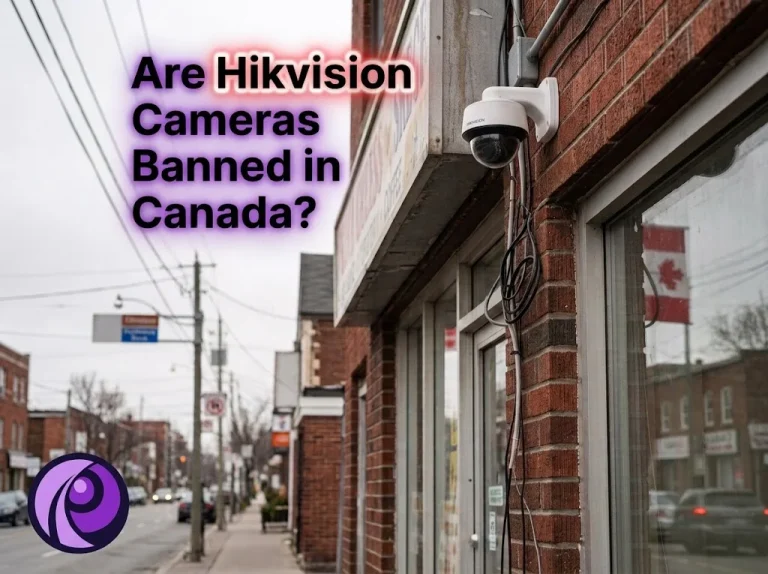
If you have Hikvision cameras on your house, your store or your condo building, the news from the past year has probably left you with one nagging question: is Hikvision banned in Canada, and are the cameras on your wall now a problem? It is a fair thing to worry about. The short version is reassuring, but the details matter, especially if you run a business, manage a rental property or work anywhere near a government contract.
Our team handles security camera installation across Toronto and the GTA, and this question comes up on site visits almost every week. Below we walk through what Ottawa actually ordered, what the courts have said so far, whether Hikvision equipment is still legal and safe to run, where Dahua stands, and how to decide whether replacing your system makes sense for you.
What the Hikvision Canada Ban Actually Covers
Most of the confusion comes from the word “ban,” which headlines used for several different measures. Once you separate them, it becomes clear who each one applies to.
| Measure | Who it applies to | What it means in practice |
|---|---|---|
| Wind-up order under the Investment Canada Act | Hikvision Canada Inc., the Canadian subsidiary | The company must stop operating and close its Canadian business, including local sales, marketing and after-sales support. |
| Federal purchase and use prohibition | Federal departments, agencies and Crown corporations | No new Hikvision purchases, plus a review of federal properties so older Hikvision equipment is not used going forward. |
| Public advisory | All Canadians and Canadian organizations | The minister encouraged people to take note of the decision and make their own choices. This is advice, not a legal requirement. |
| Quebec government ban (separate, earlier) | Quebec provincial government buildings and facilities | Hikvision and Dahua products are not used in provincial government facilities. It does not reach private owners. |
None of these rows reaches a homeowner in Scarborough or a restaurant owner in Vaughan. The legal obligations sit with the Canadian subsidiary and with public bodies. The practical effects, mostly around warranty and support, reach everyone who owns the equipment.
The Hikvision Canada Cease Operations Order: How the Shutdown Unfolded
The order came out of a national security review under the Investment Canada Act, the federal law that allows Ottawa to review foreign-owned businesses on security grounds. The government has not published the evidence behind its decision; it said the conclusion relied on information from Canada’s security and intelligence community. Here is the sequence of events.
| Date | What happened |
|---|---|
| 2015 | Hikvision Canada Inc. begins operating in Canada. Court filings later showed the national security review started after the government raised the company’s missed investment notification from that period. |
| June 27, 2025 | The federal Cabinet orders Hikvision Canada to wind up its Canadian business and cease operations. Industry Minister Mélanie Joly also announces the federal purchase and use prohibition. |
| July 7, 2025 | Hikvision files for judicial review in the Federal Court and asks for a stay (a pause) of the order. The government agrees the company can keep operating until the stay request is decided. |
| September 2025 | The Federal Court dismisses the stay request, so the order takes effect and Hikvision Canada suspends operations. Hikvision says it will keep pursuing judicial review and gives notice of a possible arbitration claim under the 2014 Canada-China investment treaty. |
| April 21, 2026 | Hikvision files a notice of discontinuance, ending its Federal Court challenge. The wind-up order remains in force. |
One detail often got lost in coverage: the September 2025 ruling was only about the stay, not a final decision on whether the order itself was lawful. The court accepted there was a serious issue to be tried, but found that the balance of convenience favoured the government. That question will not be answered in court, because Hikvision withdrew its judicial review in April 2026. The company still disputes the decision and maintains its products pose no security risk, while the government stands by its assessment.
Is It Legal to Use Hikvision Cameras in Canada?
Yes. Nothing in the federal order makes it illegal for a private person or business to own, operate or buy Hikvision equipment. Your cameras keep recording, your NVR keeps storing footage and your mobile app keeps working. There are, however, a few situations where the answer comes with conditions:
- Federal contracts and properties. If you supply, manage or operate a site for a federal department or Crown corporation, expect contract terms and site reviews to exclude Hikvision equipment. Check with the contracting authority before you install or keep it.
- Provincial and municipal buyers. Quebec’s government already bars Hikvision and Dahua in its facilities, and other public bodies may set their own procurement rules. Contractors serving them should confirm requirements in writing.
- Buying new equipment. Hikvision products can still reach the market through distributors, but the manufacturer’s Canadian arm is no longer operating. That affects how warranty claims, repairs and returns are handled, so ask the seller who will stand behind the product.
Brand choice also does not change your privacy obligations. Whatever camera you run, it still has to be aimed and managed in line with Canadian privacy rules, which is something we check during every site assessment.
Are Hikvision Cameras Safe?
This is really two questions. The first is whether the manufacturer poses a national security concern, and the government has not made its evidence public while Hikvision firmly denies any risk. The second is whether your specific system is secure, and that one is largely in your hands. It is also the part we can speak to from hands-on experience.
Like any network-connected device, Hikvision cameras have had real vulnerabilities. The best known, CVE-2021-36260, was a critical flaw in the web server of many models that let attackers take control of unpatched devices. Hikvision released a firmware fix in 2021, yet cameras that were never updated and stayed exposed to the internet were exploited for years afterward. The lesson applies to every brand: most camera compromises come from old firmware, default passwords and devices opened directly to the internet.
If you are keeping a Hikvision system, these steps close most of the realistic attack paths:
- Update camera and NVR firmware from the manufacturer’s official download portal, not from third-party files.
- Replace any default or shared password with a unique, strong admin password, and create separate lower-privilege accounts for daily viewing.
- Avoid port forwarding the NVR to the internet. Use the manufacturer’s app or a VPN for remote viewing instead.
- Put cameras and the NVR on their own network segment, separate from computers, point-of-sale terminals and guest Wi-Fi.
- Switch off services you do not use, such as UPnP, and review which user accounts exist on the recorder.
- Retire models that no longer receive firmware updates, whatever the brand.
A properly configured Hikvision system on a separated network carries far less practical risk than any camera, from any manufacturer, left on factory settings and facing the open internet.
Is Dahua Banned in Canada?
No. The June 2025 federal order named Hikvision Canada only, and there is no equivalent wind-up order against Dahua in Canada. Private owners can legally buy and use Dahua cameras and recorders.
That said, Dahua often appears alongside Hikvision in government restrictions elsewhere. Quebec’s provincial ban covers both brands in government facilities, the United States placed both on its FCC Covered List in 2022, and the UK and Australia have removed both from sensitive government sites. If your organization answers to a public-sector buyer or to a board that follows those policies, treat Dahua the same way you would treat Hikvision. For everyone else, the same hardening checklist above is what makes the real difference.
Should I Replace My Hikvision Cameras?
Not automatically. Tearing out a working system is not the only responsible choice, and for many homeowners and small businesses it is not the best use of money. The right answer depends on your situation:
| Your situation | What we usually recommend |
|---|---|
| Home or small business, system works, firmware is current and nothing is exposed to the internet | Keep it. Harden the settings, and plan a replacement when the equipment reaches the end of its useful life. |
| Older system with models that no longer receive firmware updates | Plan a replacement. At this point, age and lack of updates are a stronger reason to upgrade than the order itself. |
| A camera or NVR fails while still under warranty | Contact the installer or distributor who sold it first, since they are now the main route for warranty claims in Canada. |
| Federal contracts, federally regulated sites or critical infrastructure | Replace or schedule a migration. Compliance and client requirements come first here. |
| Your insurer, condo board or a major client raises concerns | Document the security measures in place and consider a phased replacement, starting with the most sensitive areas. |
If you do replace, the good news is that the expensive part of most systems stays put. Existing Cat6 cable runs can usually be reused, and many recorders accept ONVIF-compatible cameras from other manufacturers, which lets you swap cameras in stages instead of all at once. When country of origin matters to you or your clients, Hanwha Vision from South Korea and Axis from Sweden are the two alternatives we are asked about most.
Get a Clear Answer for Your Own System
Every system is different, and a quick look usually settles the question. During a site assessment we check your camera and recorder models, firmware status and network exposure, then give you a straight keep, harden or replace recommendation, with no pressure to buy hardware you do not need. For offices, retail and multi-unit properties, see our commercial security camera installation service, or call us to book a visit anywhere in the GTA.