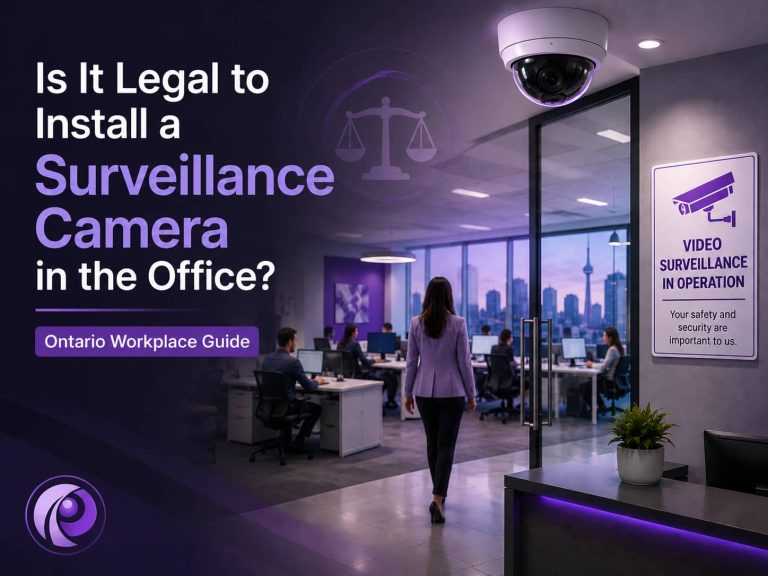
Is It Legal to Install a Surveillance Camera in the Office? (Ontario Guide)
If you’re weighing whether to add cameras to your Toronto office, the short answer is that it’s generally legal, but “legal” always comes with conditions. Ontario doesn’t have a standalone statute that spells out exactly where you can and cannot point a lens. Instead, workplace camera use is shaped by federal privacy law, provincial transparency requirements, and a body of court decisions that fill in the gaps.
None of that needs to be intimidating. Once you understand a few core principles, most offices can build a commercial security camera installation that protects the business without exposing it to employee complaints or costly lawsuits.
This guide breaks down what actually applies to a private Ontario workplace, walks through common areas like reception desks and break rooms, and answers the questions we hear most often from business owners planning an installation.
Ontario Laws That Apply to Workplace Surveillance
Ontario is a bit of an outlier among Canadian provinces. British Columbia, Alberta, and Quebec each have their own private-sector privacy statutes. Ontario does not. As a result, private businesses operating here fall under the federal Personal Information Protection and Electronic Documents Act (PIPEDA), enforced by the Office of the Privacy Commissioner of Canada (OPC).
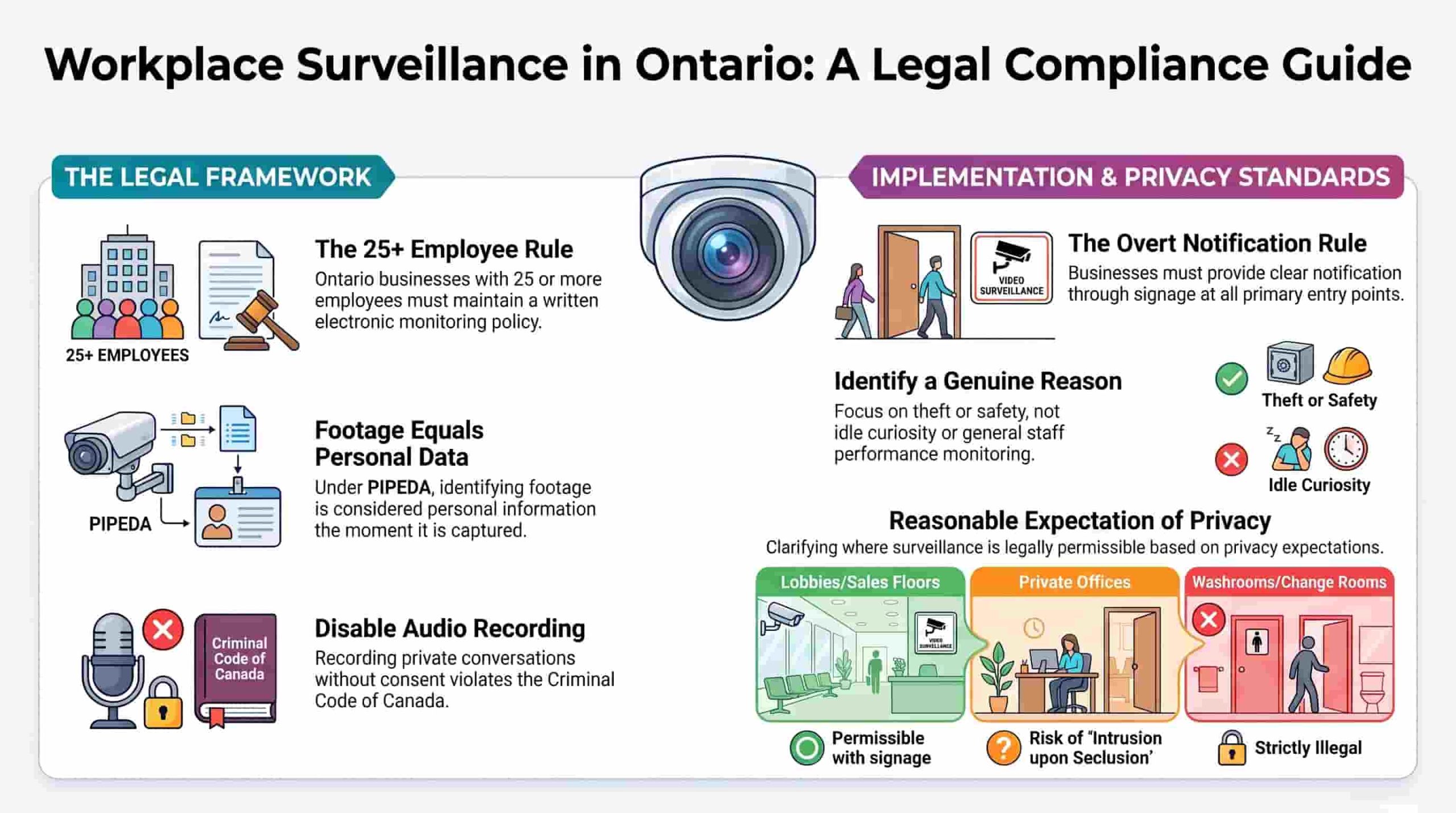
Under PIPEDA, footage that identifies a person is considered personal information the moment it is captured. That means an office camera system isn’t just a physical security tool; it’s a data collection activity. Therefore, it must meet a basic legal test: the collection must be for a purpose that a reasonable person would consider appropriate in the circumstances.
According to the official Office of the Privacy Commissioner of Canada (OPC): Guidelines for Overt Video Surveillance in the Private Sector (Joint Guidance), the practical expectations for any organization using video surveillance include:
- Identify a genuine business reason: Focus on theft prevention, access control, safety, or asset protection, not idle curiosity or general staff performance monitoring.
- Exhaust less invasive alternatives: Confirm there isn’t a less intrusive way to achieve the same security goal.
- Limit the scope of collection: Camera placement and field of view should match the actual risk, never sweeping in more workplace data than necessary.
- Provide clear notification: Inform people that surveillance is happening, typically through clear, overt signage at all primary entry points.
- Safeguard the data: Keep recorded footage secure, strictly limit who can access it, and securely dispose of it once it’s no longer needed.
Ontario’s Electronic Monitoring Policy Mandate
Separately, the Government of Ontario: Employment Standards Act, 2000 (ESA) – Electronic Monitoring Policy requirements stipulate that businesses with 25 or more employees must maintain a written electronic monitoring policy. This is a transparency obligation rather than a strict privacy restriction. It doesn’t prohibit you from using cameras, but it legally requires you to disclose, in writing, whether and how you monitor employees and exactly what that recorded information may be used for.
Important Warning on Audio: Recording private verbal conversations without the explicit consent of at least one participant violates the Criminal Code of Canada: R.S.C., 1985, c. C-46, Part VI (Interception of Communications). The safest and most compliant approach for commercial CCTV systems is to disable audio recording entirely.
Reasonable Expectation of Privacy: The Deciding Concept
Courts and privacy regulators always evaluate disputes based on an individual’s “reasonable expectation of privacy.” Areas where people expect to be observed by others, such as a lobby or a retail sales floor, carry a low expectation of privacy. Conversely, areas where people expect to be alone, such as a washroom or a change room, carry an absolute expectation of privacy, meaning cameras are strictly illegal.
Ontario case law reinforces these boundaries. In prominent wrongful dismissal cases, hidden cameras placed in private offices without the employee’s knowledge have been ruled as serious, intrusive breaches of privacy, technically known as intrusion upon seclusion. The lesson for Toronto employers is clear: covert surveillance in areas with a high expectation of privacy carries severe legal and financial risks under Canadian common law and PIPEDA framework.
Where Can You Legally Install Office Surveillance Cameras?
- Reception and Entryways: These are public-facing spaces where visitors and staff have little expectation of privacy. This is the most legally defensible spot for a camera, and it serves as your primary notification point where clear signage should be posted according to the OPC guidelines.
- Open Office / Bullpen Areas: Generally permissible for security purposes, such as after-hours entry tracking and asset protection, provided the lens isn’t positioned to target a specific individual’s desk or screen for routine performance monitoring.
- Break Rooms: This is a legal grey zone. Employees eat, take personal calls, and decompress here, meaning privacy expectations are heightened. If you have a legitimate reason, such as a documented history of workplace theft, narrow, disclosed coverage is defensible, but broad monitoring should be avoided.
- Warehouse and Storage Areas: These are highly justifiable zones. Monitoring inventory shrinkage, workplace safety incidents, and heavy equipment operation are widely accepted business purposes under PIPEDA.
- Meeting Rooms: These spaces carry a moderate-to-high expectation of privacy due to confidential HR, corporate strategy, or client discussions. If cameras are installed, their presence must be explicitly disclosed, and audio features must remain turned off to avoid violating the Criminal Code.
Quick Reference: Office Surveillance Compliance in Ontario
| Situation / Location | Generally Allowed? | Key Legal Considerations |
| Reception / Entrance | Yes | Low expectation of privacy; post clear signage at the main entryway according to OPC standards. |
| Open Office Area | Usually | Permitted for general security; avoid targeting individual desks for productivity tracking. |
| Break Room | Case-by-Case | Heightened privacy expectation; requires a specific, documented, and disclosed security purpose. |
| Warehouse / Storage | Yes | Backed by a strong, widely recognized business and safety justification under PIPEDA. |
| Meeting Rooms | Case-by-Case | Confidential discussions raise privacy stakes; must disclose clearly and turn off audio. |
| Washrooms / Change Rooms | No | Strictly prohibited under all Canadian privacy and criminal laws. |
| Private Offices (Covert) | No | Courts treat hidden cameras in private offices as a severe violation of common law privacy principles. |
Designing a Compliant System for Your Business
Every workplace layout is unique, and the ideal camera placement for a retail-adjacent office differs entirely from a commercial warehouse. When mapping out a security system for a Toronto office, it is vital to align your camera layout, signage, and written workplace policies together from day one.
If you are looking to secure your commercial property responsibly, visit our Security Camera Installation Services page to explore our services.