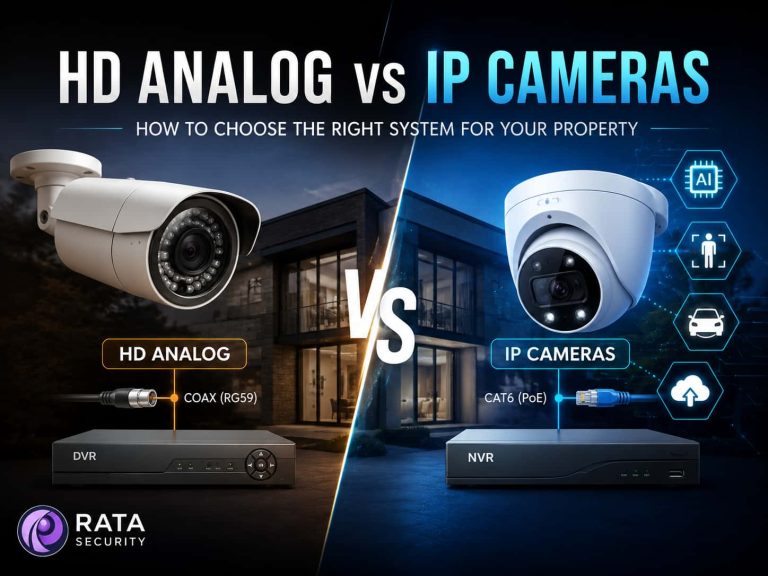
What HD Analog Actually Is, and Why It Is Not the CCTV You Remember
When people hear “analog camera” they picture the grainy, washed-out convenience store footage from twenty years ago. That association is out of date. Traditional analog topped out around 700 TV lines, roughly 0.4 megapixels. Modern HD analog is a different generation of technology that happens to travel over the same coaxial cable, and that single fact is what makes it worth understanding.
The Three Standards: HD-TVI, HDCVI, and AHD
HD analog is not one format. Three competing standards emerged to push high-definition video down a coax cable, and knowing which is which matters because your cameras and your recorder need to speak the same language.
- HD-TVI (Transport Video Interface): Developed and popularised largely by Hikvision, whose Turbo HD line is the most widely deployed HD analog series in Canada. Strong support, wide camera selection, easy to source parts for.
- HDCVI (Composite Video Interface): Dahua’s standard. Its main advantage is transmission distance and the ability to carry audio and control data alongside video on a single coax run, which matters in large warehouses and industrial lots.
- AHD (Analog High Definition): The open, lower-cost standard. Broad compatibility, but historically dominated by no-name manufacturers, so quality varies significantly from unit to unit.
Most modern DVRs are penta-brid, meaning they accept HD-TVI, HDCVI, AHD, standard analog and even a few IP channels on the same box. That flexibility is genuinely useful during a phased upgrade, and it is one of the reasons we rarely worry about locking a client into a dead-end format.
The Resolution HD Analog Actually Delivers Today
This is where the old assumption breaks down hardest. HD analog is no longer a 1080p ceiling technology, and for the majority of residential and small-commercial coverage, the image is genuinely good.
- 1080p (2MP) is the entry point and is now considered the floor, not the standard.
- 5MP and 4K (8MP) HD analog cameras are readily available and widely deployed.
- Colour night vision over coax exists. Hikvision ColorVu and Dahua Full-Color analog models deliver full-colour footage in near-darkness using a low-light sensor and a warm supplemental light.
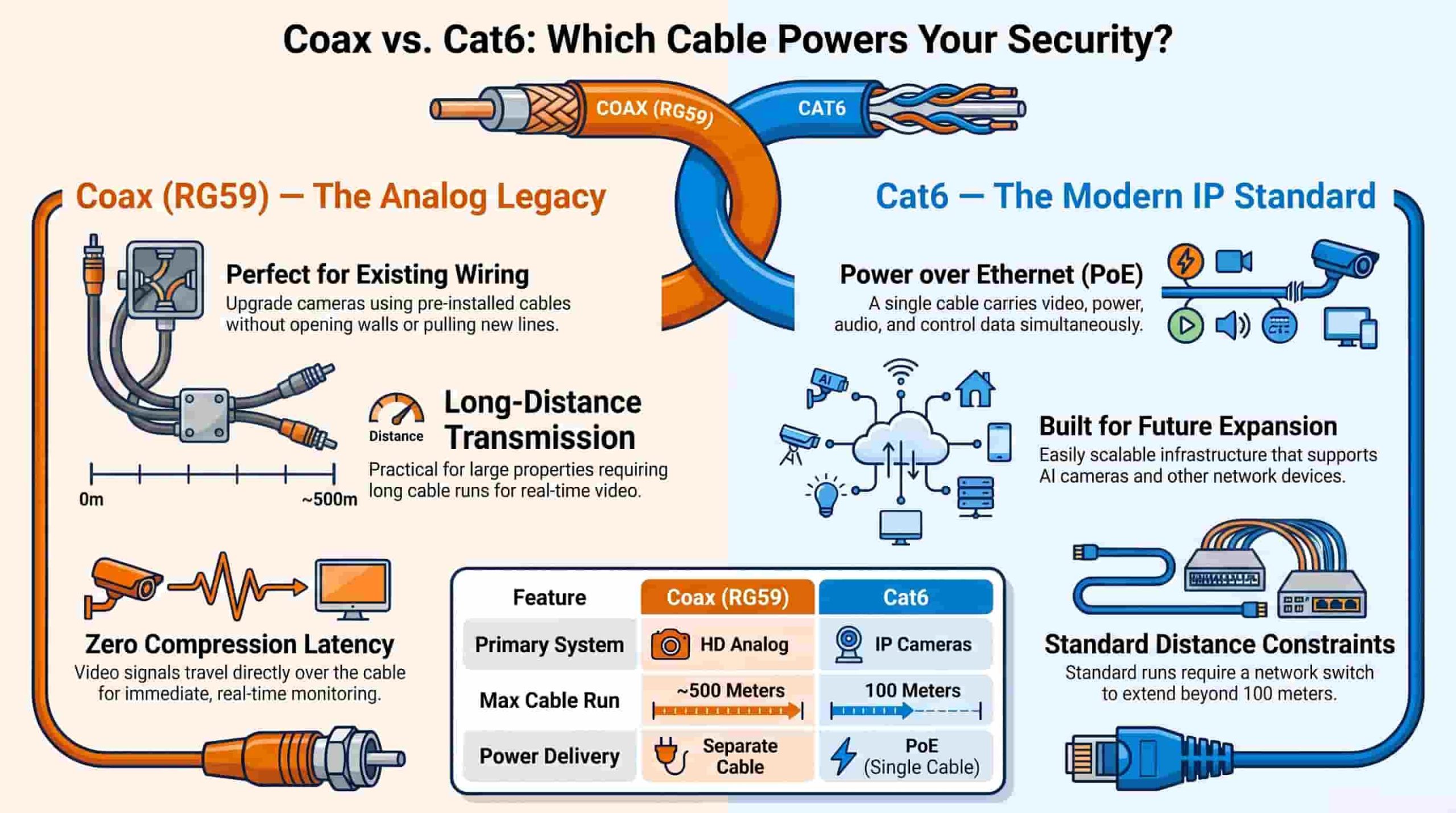
- Video travels reliably up to roughly 500 metres on quality coax, with zero compression latency, because the signal is not being packetised and sent through a network.

What IP Cameras Do That HD Analog Cannot
None of the above means HD analog is the better technology. It is the cheaper and simpler technology, which is not the same thing. There are capabilities that only exist on the IP side, and if any of them matter to your use case, the decision is already made for you.
A Higher Ceiling and Usable Digital Zoom
IP systems scale past where analog stops. 4K is common, 8MP to 12MP multi-sensor and 180 degree panoramic units are standard commercial equipment, and the extra pixel density is what makes footage forensically useful rather than merely descriptive.
The practical test is simple. Analog footage tells you that a person was there. High-resolution IP footage lets you crop into the frame afterwards and tell a police officer who that person was, or read a licence plate from across a parking lot. If your goal is evidence rather than deterrence, this difference is the whole argument.
On-Camera AI and Smart Detection
This is the gap that has widened the most in recent years. Modern IP cameras process video on the camera itself before it ever reaches the recorder, which unlocks a category of features analog cannot replicate.
- Human and vehicle classification, which filters out the raccoon, the snowfall and the swaying tree branch that would otherwise trigger a motion alert at 3 a.m.
- Line crossing and intrusion zones you can draw precisely on a floor plan rather than a crude rectangular motion box.
- Licence plate recognition, people counting, loitering detection and heat mapping, all of which are business tools as much as security tools.
- Face detection and appearance search on enterprise platforms, letting you find one person across every camera on the property in seconds.
Some AI does exist on high-end DVRs, but it runs on the recorder rather than the camera, it is meaningfully less accurate, and it does not scale. If false alarms are already driving you to ignore your phone notifications, IP is the fix.
Cabling Simplicity and Scalability
An IP camera carries video, audio, control data and power on one Cat6 cable using Power over Ethernet. Adding a camera later means running one cable to a switch port. HD analog needs a coax run for video plus a separate power run, or Siamese cable that bundles the two, and every camera consumes a physical port on the DVR. Once you outgrow a 32-channel DVR, the analog path gets awkward fast.
HD Analog vs IP Cameras: The Side-by-Side Comparison
Here is the practical summary we walk clients through on site. Read the right-hand column as a set of trade-offs, not as a scorecard, because in the field the winner depends entirely on which rows you actually care about.
| Factor | HD Analog | IP |
|---|---|---|
| Typical resolution | 1080p to 4K | 1080p to 12MP and multi-sensor |
| Cabling | Coax (RG59) plus power, or Siamese | Single Cat6 with PoE |
| Recorder | DVR | NVR |
| Reuses existing coax | Yes, this is its core advantage | No, requires new Cat6 |
| Hardware cost | Roughly 30 to 50 percent lower | Higher per camera |
| On-camera AI | Very limited | Extensive and reliable |
| Digital zoom quality | Degrades quickly | Holds detail, forensic grade |
| Latency | Effectively zero | Slight, from encoding |
| Network bandwidth used | None | Real, must be planned for |
| Max cable run | Around 500m on coax | 100m per Cat6 run without a switch |
| Scalability | Limited by DVR ports | Add a switch port and go |
| Audio on the camera | Only on some HDCVI models | Standard |
| Best fit | Retrofits, tight budgets, high camera counts | New builds, evidence-grade needs, AI |
The Cabling Question That Decides Most Projects
If you take one thing from this guide, take this. In practice, the HD analog vs IP cameras decision is settled less by feature lists and more by what is already running through your walls and how much it would cost to change that.
If Your Building Already Has Coax
Older homes and commercial units across the GTA are full of RG59 coax left behind by systems installed in the 2000s and 2010s. That cable is an asset, and it is the single strongest argument for HD analog.
- You reuse the existing runs and swap only the cameras and the recorder.
- Nothing gets opened up. No fishing new cable through finished walls, no patching, no repainting.
- Labour drops substantially, which in a retrofit is usually the largest line on the invoice.
- You still land on 4K imaging, colour night vision and phone access. The compromise is smaller than most people assume.
There is one caveat worth being honest about. Old coax is not automatically good coax. We test the runs before quoting on them, because corroded connectors, staple damage and cheap copper-clad-aluminium cable can each undermine an HD signal, and finding that out after the cameras are mounted helps nobody.
If You Are Wiring From Scratch
New construction, a gut renovation, or an unfinished basement changes the maths completely. Once you are running new cable regardless, the cabling advantage of analog disappears and the argument for IP becomes hard to counter.
- Cat6 costs roughly the same to pull as coax, and the labour is essentially identical.
- That same Cat6 backbone can later serve access points, door controllers and network drops. Coax can only ever carry video.
- You keep the option of adding AI, higher-resolution cameras and multi-sensor units later, without touching the infrastructure again.
Choosing analog on a new-build purely to save on hardware is the one scenario where we will actively talk a client out of their own request. The saving is real but small, and it caps what the building can do for the next decade.
Cost: What the Difference Looks Like in Real Dollars
Percentages are easy to quote and hard to act on, so here are indicative ranges for the Greater Toronto Area, fully installed, including recorder, drive, cabling, configuration and training. Actual figures shift with building access, cable complexity and camera specification.
| Scenario | HD Analog | IP |
|---|---|---|
| 4 cameras, home, existing coax reused | $900 to $1,400 | Not applicable, requires new cable |
| 4 cameras, home, new cable required | $1,300 to $1,800 | $1,500 to $2,200 |
| 8 cameras, small retail or office | $1,800 to $2,600 | $2,500 to $3,500 |
| 16 cameras, warehouse | $3,500 to $6,000 | $5,000 to $9,000 |
| Adding one camera later | New coax plus power run, free DVR port needed | One Cat6 run to a free switch port |
Notice what happens across the rows. The gap is widest when coax already exists and narrows sharply once new cable enters the picture. That is the whole economic story of HD analog in one table.
A Five-Minute Decision Framework
Run through the three groups below. Whichever one describes the most of your situation is your answer, and if you find yourself split across two of them, the hybrid section covers you.
Choose HD Analog If
These are the conditions under which we recommend analog without hesitation, and where we think the technology is genuinely underrated rather than merely cheap.
- Your property already has usable coax in the walls.
- Your budget is fixed and you would rather have ten cameras at 4MP than five at 4K, because coverage beats resolution when the goal is eliminating blind spots.
- You need long cable runs across a large site where the 100 metre Ethernet limit would force you to add switches.
- You want the surveillance system fully off your business network, with no bandwidth impact and no shared attack surface.
- Your goal is deterrence and general awareness rather than courtroom-grade identification.
Choose IP If
Conversely, these conditions make IP the correct answer even when the upfront number is higher, because the cost of getting this wrong is footage you cannot use.
- You are building new or already opening walls.
- You need to identify faces or read licence plates, not just observe that an event happened.
- You are drowning in false alerts and need reliable human and vehicle filtering.
- You want business analytics such as people counting, queue monitoring or heat mapping.
- You expect to grow past 16 cameras or across multiple sites.
- Your industry, insurer or landlord has a documented resolution or retention requirement.
When a Hybrid System Is the Right Call
The false premise in most comparison articles is that this is an either-or decision. It frequently is not, and hybrid is often the smartest use of a budget.
A penta-brid recorder accepts both signal types on one box. That lets you keep the existing coax cameras covering low-priority areas such as a stockroom or a side corridor, and spend the budget where it counts by running Cat6 to two or three IP cameras at the entrance, the till and the loading door. Every dollar goes to the positions where image quality actually changes an outcome.
We build systems like this regularly for commercial properties and residential clients across the GTA, and it is usually the option that no one thought to ask for.
Five Mistakes We See in the Field
These come up on almost every site survey where somebody has already bought equipment, and each one is avoidable with about ten minutes of forethought.
- Buying 4K cameras and pairing them with a recorder that cannot decode 4K. The cameras downscale and you paid for nothing.
- Assuming the old coax is fine. Copper-clad aluminium and corroded BNC ends will not carry an HD signal cleanly, and no camera will fix that.
- Undersizing the hard drive. Higher resolution means larger files. A 4K system on a 1TB drive will quietly overwrite the footage you needed before you go looking for it.
- Putting IP cameras on the main business network with no VLAN separation. It is both a bandwidth problem and a security problem.
- Choosing based on camera resolution alone while ignoring placement. A well-positioned 2MP camera at eye level beats a badly aimed 4K unit mounted under the roofline every single time.
The Bottom Line
HD analog is not the compromise it is often made out to be, and IP is not automatically the right answer just because it is newer. Analog is the correct choice when coax already exists, the budget is real and coverage matters more than forensic detail. IP is the correct choice when you need evidence, intelligence and room to grow.
If you are not certain which side of the line your property sits on, the honest answer is that a fifteen minute site walk will tell you more than any article can, because the answer is usually hiding in your walls.
RATA Security designs and installs both HD analog and IP systems across Toronto and the GTA, and we test your existing cabling before we quote so you know exactly what you are working with. Book a free on-site assessment or call us at (647) 594-1360. If you want the full breakdown of our process, equipment and pricing, our security camera installation in Toronto page covers it in detail.