Choosing the Best Building Site Surveillance Camera
Construction sites in Toronto, Markham, and the wider Greater Toronto Area (GTA) present some of the most challenging environments for asset protection. Active projects are highly vulnerable to tool theft, copper wire theft, vandalism, and costly liability claims. Managing these risks requires a strategic approach to physical security.
Selecting the best building site surveillance camera is not just about buying high-resolution hardware. It requires understanding how different technologies perform under harsh environmental conditions, how they transmit data, and how they integrate into a broader security framework.
Key Security Challenges on GTA Construction Sites
Before evaluating hardware, it is essential to understand the specific operational challenges that construction sites face in Southern Ontario.
Harsh Weather and Environmental Conditions
GTA construction sites experience extreme seasonal shifts. Surveillance hardware must operate reliably in freezing winter temperatures, heavy snowfall, summer humidity, and dusty, high-debris environments. Equipment failure due to weather can leave a site vulnerable at critical times.
Power and Connectivity Constraints
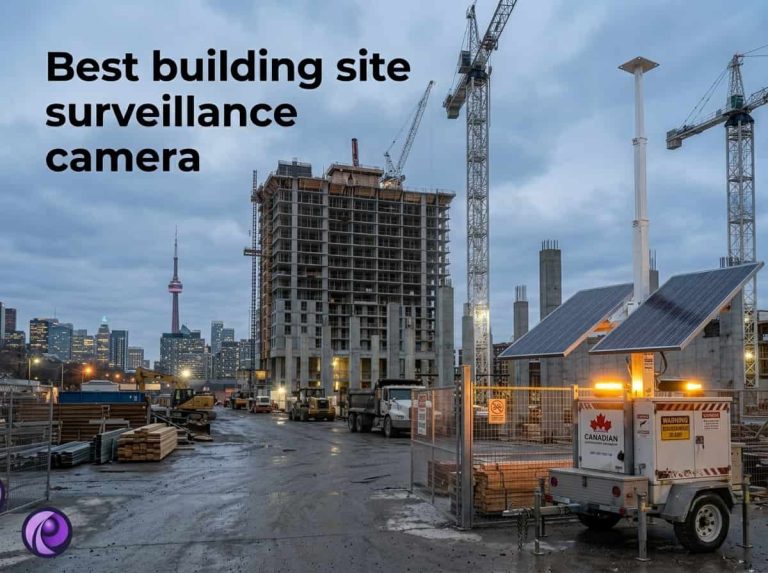
During the early phases of excavation and framing, utility infrastructure is rarely available. Security systems must often rely on temporary power sources, solar panels, or battery packs. Similarly, internet access is usually restricted to cellular networks, requiring cameras that can transmit data efficiently over mobile bands.
Evolving Site Topography
Unlike static commercial buildings, construction sites change daily. A camera angle that provides clear visibility on Monday might be blocked by a pile of drywall or a new concrete pour by Thursday. Security solutions must be flexible, scalable, and easy to reposition.
Essential Features of Construction Site Cameras
When selecting cameras for building sites, look for specific technical characteristics that address these operational challenges.
Remote Monitoring and Cellular Connectivity
Modern construction security relies on remote monitoring. Because on-site guards can be expensive and limited in scope, cameras equipped with 4G or 5G cellular modems allow off-site teams or professional monitoring centers to view live feeds. Look for systems that support efficient video compression, such as H.265, to minimize cellular data usage while maintaining high image resolution.
Advanced Night Vision
Most construction site crimes occur under the cover of darkness. Standard infrared night vision provides black-and-white imagery, which can make it difficult to identify suspect vehicles or clothing colors. Active color-at-night technology, which uses ultra-low-light sensors or built-in white-light illuminators, provides highly detailed color video even in complete darkness.
Robust Weather Resistance
To survive the GTA climate, cameras must carry high Ingress Protection (IP) ratings. An IP66 rating indicates protection against heavy dust and high-pressure water jets, while IP67 or IP68 ratings offer even greater resistance. For vandalism protection, select cameras with an IK10 impact resistance rating.
Artificial Intelligence (AI) Detection
Older motion detection systems trigger alerts based on any pixel changes, leading to frequent false alarms caused by wind, blowing debris, or small animals. Artificial Intelligence (AI) detection uses onboard deep-learning algorithms to specifically identify humans and vehicles. This filtering ensures that security personnel only receive alerts when an actual threat is present.
Flexible Power Solutions
For sites without stable electricity, look for cameras that support Power over Ethernet (PoE) for simple single-cable installation when power is available. For off-grid phases, solar-powered surveillance trailers or heavy-duty battery enclosures are necessary to maintain continuous operation.
360-Degree Field of View
On large construction sites, maintaining visibility across multiple work zones can be challenging. Cameras with a 360-degree field of view provide comprehensive coverage from a single installation point, helping reduce blind spots and improve situational awareness while lowering the need for multiple fixed cameras in open areas.
Unbiased Brand Comparison for Construction Site Use
To find the right system, it is helpful to compare how leading manufacturers approach these technical requirements. No single brand is ideal for every scenario. Each has distinct technical strengths and limitations.
Hikvision
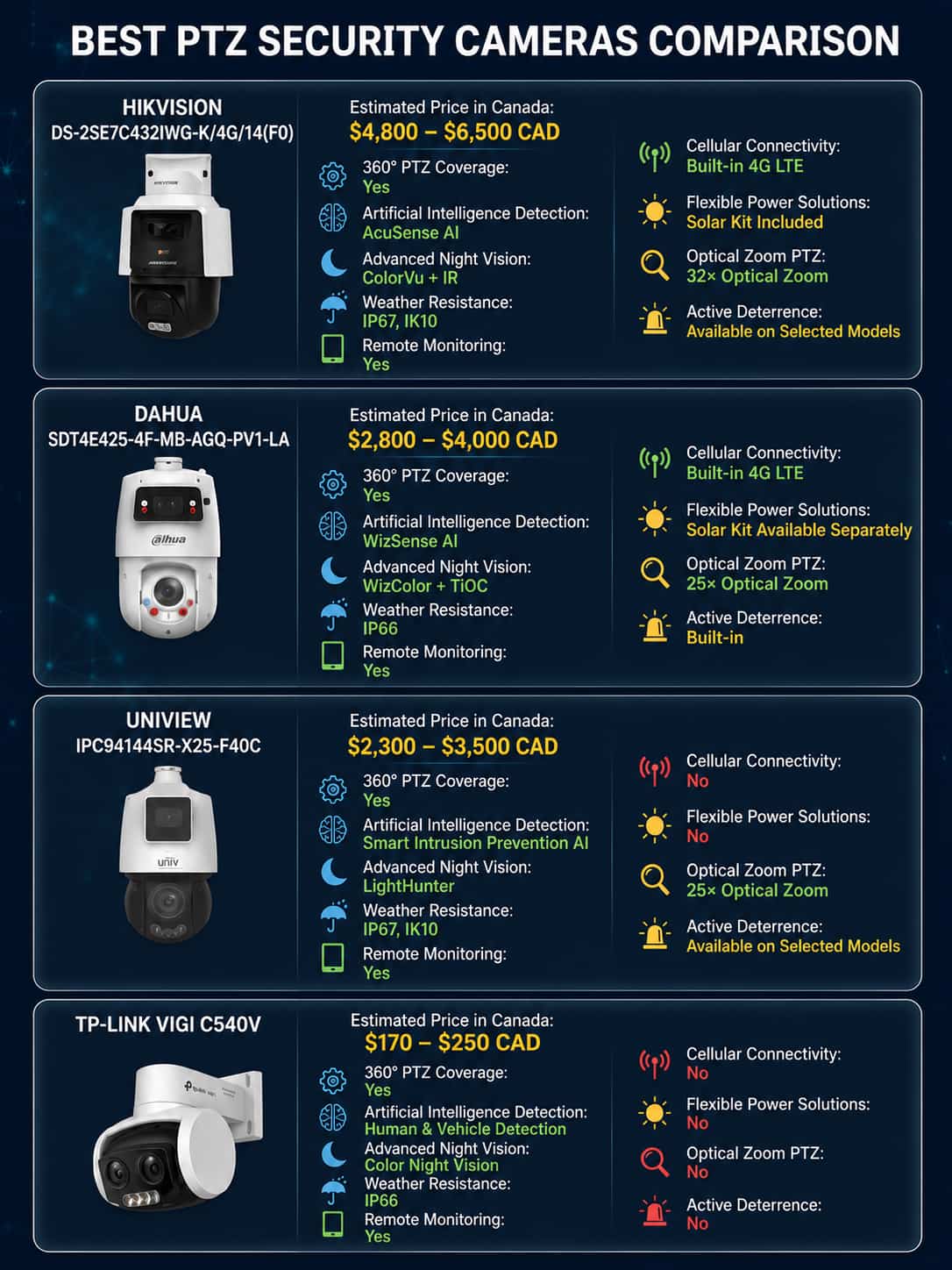
For construction projects that require wide-area coverage without permanent power or wired internet, Hikvision’s DS-2SE7C432IWG-K/4G/14(F0) TandemVu Solar-powered PTZ is a practical solution. It combines panoramic monitoring with a 32x optical zoom PTZ camera, allowing security teams to maintain continuous site awareness while focusing on specific incidents when needed. With built-in 4G connectivity, solar-powered operation, AI-powered human and vehicle detection, ColorVu low-light imaging, and IP67 weather protection, it is well suited for remote construction sites where flexibility and reliability are essential.
Dahua Technology
Dahua SDT4E425-4F-MB-AGQ-PV1-LA
For construction sites where reliable surveillance and rapid incident response are priorities, the Dahua SDT4E425-4F-MB-AGQ-PV1-LA provides a practical combination of intelligent monitoring and outdoor durability. Its dual-camera design offers continuous wide-area coverage alongside a 25x optical zoom PTZ camera, while WizSense AI improves the accuracy of human and vehicle detection to reduce false alarms. With built-in 4G connectivity, active deterrence features, and an IP66-rated weather-resistant enclosure, it is well suited for construction environments that require dependable remote monitoring throughout every stage of a project.
Uniview
Uniview IPC94144SR-X25-F40C
For construction sites that require reliable surveillance across large outdoor areas, the Uniview IPC94144SR-X25-F40C delivers a balanced combination of intelligent monitoring and long-range visibility. Its dual-camera design provides 360° PTZ coverage alongside a 25x optical zoom camera, helping security teams monitor broad work zones while focusing on specific events when needed. With AI-powered human and vehicle detection, LightHunter low-light imaging, an IP67 weather-resistant and IK10 vandal-resistant housing, plus support for remote monitoring over IP networks, it is well suited for construction environments where dependable performance and flexible deployment are essential.
TP-Link
TP-Link VIGI C540V
For smaller construction sites and temporary project offices with existing network infrastructure, the TP-Link VIGI C540V provides a straightforward and cost-effective surveillance solution. Its 360° PTZ coverage offers flexible monitoring across active work areas, while AI-powered human and vehicle detection helps improve alert accuracy and reduce unnecessary notifications. Combined with Color Night Vision, an IP66 weather-resistant design, and support for remote monitoring through the VIGI platform, it is a practical option for projects that prioritize ease of deployment and reliable day-to-day site monitoring.
| Feature | Hikvision DS-2SE7C432IWG-K/4G/14(F0) | Dahua SDT4E425-4F-MB-AGQ-PV1-LA | Uniview IPC94144SR-X25-F40C | TP-Link VIGI C540V |
| Estimated Price in Canada (CAD) | $4,800 – $6,500 | $2,800 – $4,000 | $2,300 – $3,500 | $170 – $250 |
| 360° PTZ Coverage | Yes | Yes | Yes | Yes |
| Artificial Intelligence (AI) Detection | AcuSense AI | WizSense AI | Smart Intrusion Prevention AI | Human & Vehicle Detection |
| Advanced Night Vision | ColorVu + IR | WizColor + TiOC | LightHunter | Color Night Vision |
| Robust Weather Resistance | IP67, IK10 | IP66 | IP67, IK10 | IP66 |
| Remote Monitoring | Yes | Yes | Yes | Yes |
| Cellular Connectivity (4G LTE) | Built-in | Built-in | No | No |
| Flexible Power Solutions | Solar Kit Included | Solar Kit Available Separately | No | No |
| Optical Zoom PTZ | 32× Optical Zoom | 25× Optical Zoom | 25× Optical Zoom | No |
| Active Deterrence | Available on Selected Models | Built-in | Available on Selected Models | No |
Best Practices for Deploying Site Security
To maximize the effectiveness of your chosen system, implement these industry best practices:
- Conduct a Comprehensive Site Assessment: Identify high-risk areas, such as material storage yards, tool trailers, and entry points, before placing cameras.
- Ensure Multi-Layered Coverage: Combine thermal cameras for long-range perimeter detection with high-resolution optical cameras for detail verification.
- Use Active Deterrence: Select cameras equipped with strobe lights and audio alarms to warn intruders they are being monitored before they can commit a crime.
- Maintain Proper Mounting Height: Mount cameras high enough to prevent physical tampering, but at an angle that still allows clear facial and license plate recognition.
- Implement Regular Maintenance: Keep lenses clean of dust and debris, and check power connections regularly to avoid system downtime.
Integrating high-quality cameras with a professionally designed commercial security program is the most reliable way to protect your investments. At Rata Security, we design our tailored surveillance solutions around these very principles: discover more about our methodology on our About Us page.
Contact Rata Security Today
Are you planning a new construction project in Toronto or Markham? Let our experienced consultants help you design, deploy, and maintain a custom surveillance system tailored to your specific site. Contact Rata Security today for a professional security camera installation consultation.