What Access Control Actually Solves
Most businesses do not install access control because they had a break in. They install it because managing physical keys stopped being viable, and because they needed to answer a question they could not answer before: who was in the building at the time.
A credential based system replaces the copying problem with a database problem, which is one you can actually manage. When someone leaves, their credential is deactivated in under a minute and no hardware changes. When an incident happens, the audit trail tells you which door opened, with whose credential, at what second, and if the doors are tied to cameras, it takes you straight to that clip instead of scrubbing through hours of footage. And because permissions are set per door and per schedule, a cleaning contractor can have the rear entrance between six and nine in the evening and nothing else, which is not something a key can do.
Access Control Systems We Install
The right credential type depends on how many people need access, how often that list changes, and what level of security the space warrants. Most GTA buildings we work in end up with a mix.
Card and Fob Systems
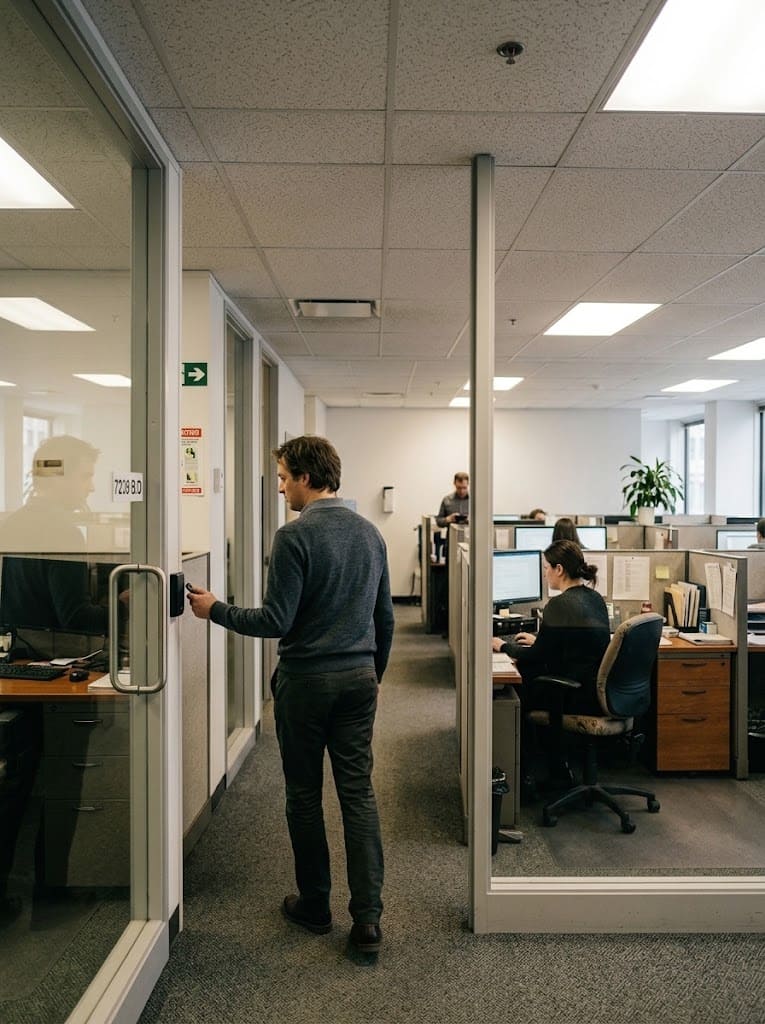
The standard for offices and warehouses. Users present an encrypted card or key fob to a reader at the door, and the door controller checks the credential against permissions before releasing the lock.
- Encrypted 13.56 MHz credentials rather than legacy 125 kHz proximity cards, which can be cloned with hardware available online
- Per user, per door and per schedule permissions
- Instant deactivation of lost or retained credentials
- Full audit trail exportable for HR, insurance or police
Mobile Credentials
The credential lives on the user’s phone over Bluetooth or NFC, which removes the ongoing cost and administration of issuing physical cards entirely.
- New staff are provisioned remotely, with no need to be on site to collect a card
- Access is revoked instantly and remotely when someone leaves
- Practical for businesses with rotating contractors or multiple sites
Keypad and PIN Entry
Suitable for lower traffic doors, storage rooms and secondary entrances where issuing credentials to everyone is not warranted.
- Individual PIN codes so entries are still attributable rather than shared
- Often paired with a card reader for two factor entry on higher security doors
- Weather rated keypads for exterior and gate positions
Video Intercom and Entry Systems
For condominium lobbies, multi tenant entrances and reception controlled offices, where the person deciding to grant entry is not standing at the door.
- Video intercom at the main entrance with call routing to a suite, a desk or a mobile app
- Remote door release from a phone, useful for deliveries and after hours access
- Elevator control so a credential restricts which floors a user can select
- Integration with the building’s camera system so every entry event has matching footage
Biometric Readers
Fingerprint and facial readers for high security areas such as server rooms, cash offices and controlled inventory. These carry privacy obligations that card systems do not, which we cover in the compliance section below.
Door Hardware and Locking
The reader is the visible part of an access control system and the least important. What determines whether a door works reliably for five years, and whether it passes inspection, is the locking hardware and how it is wired.
Magnetic Locks and Electric Strikes
Maglocks hold a door closed with an electromagnet and are fail-safe, meaning they release when power is cut. Electric strikes replace the door frame keeper and are usually fail-secure, meaning they stay locked without power. Which one a door gets is a code question, not a preference, and getting it wrong is the most common defect we find on existing systems.
Request to Exit and Free Egress
Every controlled door needs a compliant way out without a credential, whether that is a request to exit sensor, a push bar with an integrated switch, or panic hardware on an egress route. Under the Ontario Fire Code, occupants must be able to leave without special knowledge or a key, and a maglock on a required exit needs the correct release and fire alarm interface.
Door Position and Monitoring
A door position switch tells the system whether the door actually closed. Without it you have no way of knowing that a door was propped open for two hours, which is how most access control systems get quietly defeated in practice.
Automatic Operators and Accessibility
Where accessible entry is required, a power door operator is tied into the access control sequence so the door unlocks and opens in the correct order. This is an AODA consideration on many commercial and multi tenant properties.
Integration With Cameras and Alarm
Access control produces a log of events, and cameras produce footage. Separately each answers half a question, which is why we build them to talk to each other whenever the platforms allow it.
Door events can create camera bookmarks, so a specific badge use jumps straight to the clip rather than a timestamp you have to hunt for. Forced door and door held open events can trigger an alert to your phone with a live view attached. And on the alarm system side, a valid credential at the entrance can disarm the zone automatically, which removes the most common cause of false alarms, staff entering and forgetting the code.
Where We Install Access Control
Requirements shift substantially depending on what the building does and who has the right to be inside it. These are the property types we work on most across the GTA.
Offices and Professional Buildings
Main entrance, server room, records storage and after hours perimeter, usually with scheduled unlock during business hours and credential only access outside them.
Warehouses and Industrial
Personnel doors, shipping and receiving entrances, yard gates and high value storage areas. Often paired with LPR at the gate so vehicle and credential events can be reconciled.
Condominiums and Multi Tenant Buildings
Lobby video intercom, parking garage entry, amenity rooms and elevator floor restriction. These projects require board approval and a defined policy on who administers credentials, and we supply that documentation alongside the technical design.
Retail and Restaurants
Back of house doors, stock rooms and cash offices, where the goal is limiting internal access rather than stopping outsiders at the perimeter.
Our Installation Process
Access control touches life safety hardware and existing door frames, which means the survey stage carries more weight here than on any other system we install.
Step 1: Door by Door Survey
We assess every door individually: frame type, existing hardware, whether it sits on an egress route, power availability and cable pathway. You receive a door schedule listing the hardware and lock type specified for each opening, plus a written fixed price quote.
Step 2: Cabling and Hardware Installation
Controllers, readers, locks, request to exit devices and door contacts are installed and wired back to a central enclosure over Cat6. Fire alarm interface is connected where maglocks are used on egress doors.
Step 3: System Configuration
Users, credentials, door groups and schedules are built to your structure. Administrator accounts are created per role so the office manager and the owner are not sharing one login. Camera and alarm integrations are configured and tested.
Step 4: Testing, Training and Handoff
Every door is tested for correct lock behaviour, free egress and fire alarm release before signoff. We train your administrator on adding and removing users, pulling reports and handling lockouts, and leave a written door schedule and system document. Coverage is a 2-year warranty on workmanship and equipment.
Access Control Installation Cost in Toronto
Access control is quoted per door rather than per building, because a glass storefront entrance and an interior wood door with power nearby are entirely different jobs. The ranges below reflect completed GTA installations and every quote is fixed price before work begins.
| Scope | Typical build | Installed cost (CAD) |
| Single door | Reader, controller, electric strike, REX, door contact | $1,200 to $2,200 |
| Two to four doors | Shared controller, mixed strike and maglock hardware | $3,500 to $8,000 |
| Office fit out | 6 to 10 doors, scheduled unlock, camera integration | $8,000 to $18,000 |
| Condo or multi tenant | Video intercom, garage entry, elevator control | Quoted after survey |
| Credential add on | Cards or fobs, per unit | $5 to $15 each |
The variables that move a quote most are whether power exists at the door, glass or masonry frames requiring specialised mounting, fire alarm interface work, and whether an existing system can be reused rather than replaced.
Compliance and Privacy in Ontario
Access control sits at the intersection of security, life safety and privacy law, and the failures we are called to correct are almost always compliance failures rather than technical ones. Under the Ontario Fire Code and Ontario Building Code, occupants must be able to exit without a key, a code or special knowledge, and any electromagnetic lock on a required egress door must release on fire alarm and on loss of power. Accessible entrances may carry AODA obligations that affect how the door operator and the access sequence are wired together. On the data side, an access control system creates a detailed record of employee movement, which brings it under PIPEDA for federally regulated employers and under general privacy expectations for everyone else, so retention of that log should be a defined policy rather than indefinite by default. Biometric data carries a higher standard again, since a fingerprint cannot be reissued the way a card can, and it should only be deployed where the security case genuinely warrants it. We address all of this at the survey stage rather than at inspection.
Areas We Serve
We install and service access control across Toronto and the wider GTA, including the Downtown Core, Midtown, the East and West ends, North York, Scarborough, Etobicoke, Markham, Mississauga, Brampton, Vaughan, Richmond Hill and Burlington. Same day emergency service is available across Metro Toronto, which matters when a controller fails and a door will not release.